Core guide
How can I stop online casino gambling and find support?
Understand Gamstop Online, device blocks, bank support and talking to someone, with a simple private next-step aid and current source links.
You can start with one conversation
If online casino gambling is taking more space in your life than you want, you can ask for support now. You do not have to decide on a label for yourself or prepare a perfect account of what happened. A short opening such as “I am worried about my gambling and would like help” gives a support conversation somewhere to begin.
The NHS describes help for gambling-related problems, including specialist treatment and support for affected family members or friends. In England, its guidance explains that people can self-refer to specialist gambling clinics or ask a GP about services in their area. Availability and referral routes should be checked with the service concerned.
This guide separates several practical tasks: talking to someone, blocking accounts, limiting device access and asking a bank for support. They can be considered together, but completing one does not mean you must manage the rest alone. Nor does a checklist need to be finished before seeking help.
Our note on making space for a pause offers a shorter starting point. Here, the aim is to help you understand what each support route does, what to ask and where personal details belong. There are no casino offers or replacement gambling suggestions on this page.
Sources: NHS: Help for problems with gambling.
If the situation feels urgent, use urgent help
If you cannot keep yourself or someone else safe, call 999 or go to A&E now. The NHS treats a mental health emergency as seriously as a physical emergency. You do not need to finish reading this guide or complete an online exercise first.
For urgent mental health help in England, the NHS advises calling 111 and selecting the mental health option, or asking for an urgent GP appointment. The linked NHS page explains these routes. If you are elsewhere, use the urgent service for your location; do not assume every local pathway uses the same menu or referral system.
The planning aid on this page is not an emergency service. It does not monitor answers, notify anyone or connect you to a clinician. It also does not ask you to score symptoms or decide whether your situation is serious enough for help.
If another person is helping you read this, they can support you in contacting the appropriate service. They do not need to act as a counsellor or resolve the financial consequences before help is requested. The immediate purpose is reaching someone able to assess and support the situation.
What Gamstop Online blocks
Gamstop Online describes a free service that blocks registration and use of online gambling accounts with companies licensed in Great Britain. Its current information offers exclusion periods from six months up to five years. It says the registration cannot be cancelled during the chosen period and continues afterward unless removal is requested.
That is an account-access measure. It is useful to understand its stated coverage rather than imagine it is a universal switch controlling every device, payment or form of gambling. The service’s own pages explain the registration and identity details it needs. Enter that information with the official service, not in this publication’s widget.
After registering, keep the details used for the exclusion current through Gamstop’s official account route. Keep any confirmation somewhere you can find it. If something does not appear to work as expected, contact the service or operator through the appropriate official channel rather than trying to work around the restriction.
You can ask an adviser to help you understand the process before or while you use it. Knowing what a service covers is part of making an informed support plan; it is not a reason to delay seeking help until every possible technical question has been answered.
Sources: Gamstop Online: How it works.
Account exclusion and device blocking are different layers
The NHS lists both self-exclusion and gambling-blocking software among practical measures alongside support. The difference is the place each measure acts. An account exclusion concerns access through covered operators. Device software concerns access on the devices where it is installed and configured.
Before installing a product, check its official instructions, supported devices and current cost or access arrangements. An old article describing a free offer may not describe the current arrangement. A support adviser can help identify an appropriate route without requiring you to visit casino pages to compare it.
Think about the devices you actually use, including a phone, tablet and computer where relevant. The useful question is whether the intended protection is set up on each applicable device. There is no need to test that by making a gambling transaction. Use the provider’s documented checks and support instead.
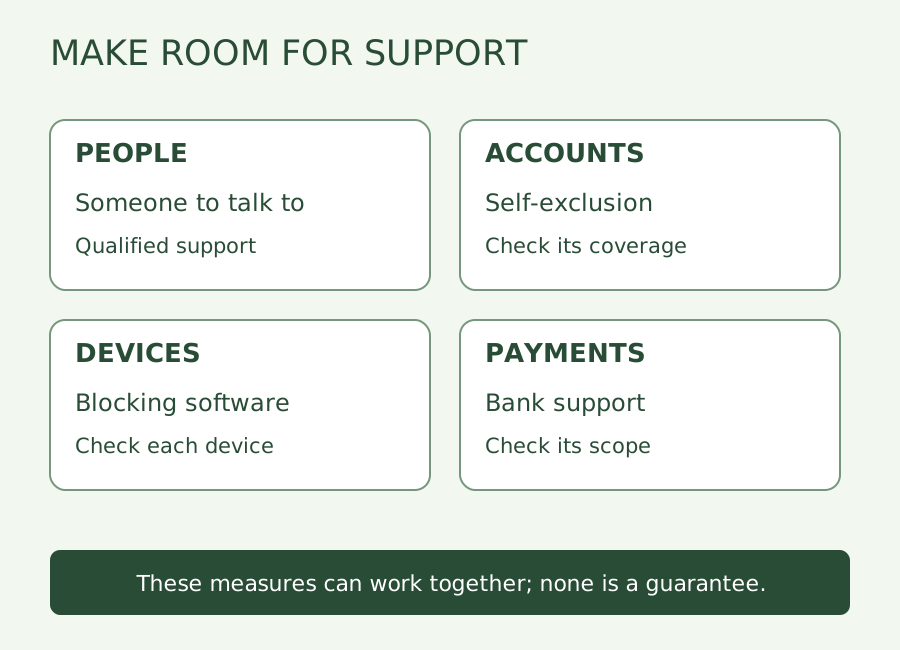
The diagram keeps devices and accounts in separate boxes because one does not automatically complete the other. It also includes people and payments. A technical barrier can create useful space, while a conversation can address concerns that a block cannot hear or understand. Neither needs to be treated as a substitute for the other.
Sources: NHS: Help for problems with gambling.
Ask the bank what its block covers
Monzo’s current help explains that its gambling block identifies card payments using transaction category codes. It also makes clear that those blocks concern card payments and that customers can ask for support with other payment types. This is a specific bank example, not a promise that every bank uses the same controls.
The practical questions for your own bank are straightforward: what gambling support is available, which accounts and payment types does it cover, how is activation confirmed and what additional help can its support team provide? Use the bank’s own app, website or established telephone route to ask.
If you have more than one bank or payment account, an action in one account should not be assumed to change all the others. A private list of the providers you use can help organise the conversations. You do not need to give this publication the list or any account information.
Keep banking passwords, card numbers and security codes out of general chats or worksheets. If a trusted person is helping, use the bank’s approved arrangements for any account access rather than sharing credentials. The aim is support with appropriate boundaries, not creating another problem while trying to reduce gambling access.
Sources: Monzo: How blocks work.
Make the first contact manageable
GamCare’s current website lists adviser support on 0808 8020 133, available 24 hours a day, seven days a week, and a live-chat route. Its website also explains other forms of support. Use the service’s current information to choose a suitable channel and understand how it handles privacy.
You can prepare a few ordinary notes if that makes the conversation easier: what is worrying you, whether you want help stopping or reducing gambling, and what practical step feels hardest. You do not need exact totals or a complete history to make an initial contact. If speaking is difficult, check the available written-contact options.
It may help to ask what happens next. A conversation might lead to information, a referral or another appointment depending on the service and your needs. Ask how to reconnect if you are interrupted or need more time. These are reasonable questions, especially when the process is unfamiliar.
Our prompt selector supplies a possible starting sentence and preparation question. It does not send that sentence anywhere. You can use the idea in your own words, ignore it or go straight to the service. The prompt is an aid to starting, not a script that you must follow.
Sources: GamCare: Support starts here.
If someone else’s gambling is affecting you
Support is also relevant when the gambling belongs to a partner, relative or friend. The NHS includes affected family members and friends in its support information. You can seek help for the effect on you without waiting for the other person to agree that there is a problem.
You do not have to take responsibility for diagnosing them, monitoring every action or controlling their accounts. A support service can help you discuss your own needs and boundaries. If shared finances are involved, the appropriate bank or qualified adviser can explain options for the actual account arrangement.
A practical first conversation can name the effect on you: worry, uncertainty about shared money or difficulty knowing how to respond. It does not require you to present a case against the other person. Keep private information to what is necessary for the support you are requesting.
If you are helping someone use exclusion or blocking services, let the official service explain its consent and identity requirements. Do not impersonate them or enter their details into an unrelated tool. Support can mean sitting with someone while they contact a service, helping them find the right page or making your own call for advice.
Sources: NHS: Help for problems with gambling.
Choose a next step without turning it into a test
The final exercise has five topics: talking, accounts, devices, banks and support for someone close to you. Selecting one reveals a short prompt. It deliberately collects no narrative, amount lost, health information or identity details. Your selection is not saved or sent.
The exercise gives no score because there is no mark to achieve before support becomes valid. Our limits note also explains why a control should not be read as a guarantee. A completed setup screen does not measure wellbeing, and an incomplete checklist does not mean help has failed.
You might choose to contact a service first and discuss the technical steps later. You might already have a block and want help with what remains difficult. The guide does not prescribe one order for everyone. Its purpose is making the available roles clearer so the next conversation can be more concrete.
Keep useful official contacts somewhere accessible to you. If circumstances change or an earlier step was not enough, return to support rather than treating the original plan as a final verdict. This page is a reference for those conversations; it cannot replace the people and services able to respond to your own situation.
A topic selector displays a preparation prompt without asking for personal information.
Questions answered
Do I need a diagnosis before asking for gambling support?
You can ask for support when you are worried. The initial conversation does not require a diagnosis or a completed plan.
Is Gamstop Online the same as blocking software?
No. Gamstop Online covers account access with GB-licensed online operators; device software acts on configured devices. Read each service’s current scope.
Does this worksheet register me with Gamstop or contact my bank?
No. It only displays a preparation prompt. Registration and bank changes must take place through the relevant official service.