Facts checked Article
Practical support
A deposit-limit increase needs more than a waiting clock
Know what your limit counts, when it resets and what remains in force while a higher amount is pending. You can lower a boundary or stop without waiting to use it up.
Support is available before you change a setting
For gambling support, contact GamCare through its official support page. The Gambling Commission lists the National Gambling Helpline on 0808 8020 133 in England and Scotland and 0808 2819 265 in Wales, available 24 hours a day. If there is an emergency, call 999.
You do not need to finish a casino session or reach a spending limit before seeking help.
A customer-requested increase to a financial limit requires a cooling-off period of at least 24 hours and a positive confirmation after that period under the Commission's RTS 12D. A countdown ending is therefore not, on its own, the same as the customer confirming a higher limit. Reductions must take effect immediately unless a systems or technical failure prevents this.
This page helps you read the setting and keep a private record. It does not recommend a gambling amount, apply a control to your account or assess whether gambling is manageable for you. Choosing to stop is a valid starting point.
The sources were checked on 19 September 2026; a forthcoming change described below remains future-dated at that check.
Sources: Chat to us now; Help for problems with gambling; RTS 12 – Financial limits.
Support first, then the setting
- Free helplines
- The Gambling Commission lists the National Gambling Helpline on 0808 8020 133 in England and Scotland and 0808 2819 265 in Wales, available 24 hours a day. GamCare offers confidential support through its official support page.Chat to us now · as checked on
- Emergency
- If there is an emergency, call 999. You do not need to finish a casino session or reach a spending limit before seeking help.Help for problems with gambling · as checked on
- The cooling-off rule
- A customer-requested increase to a financial limit requires a cooling-off period of at least 24 hours and a positive confirmation after that period under the Commission's RTS 12D. A countdown ending is not, on its own, the same as confirming a higher limit.RTS 12 – Financial limits · as checked on
- Reductions
- Reductions must take effect immediately unless a systems or technical failure prevents this, and the customer must then be told when the reduction will take effect.RTS 12 – Financial limits · as checked on
- What this page does
- It helps you read the setting and keep a private record. It does not recommend a gambling amount, apply a control to your account or assess whether gambling is manageable for you. Choosing to stop is a valid starting point.RTS 12 – Financial limits · as checked on
The contacts come before the rule. You can stop at any line; nothing on this page is saved or sent.
Name what the limit actually counts
Before looking at the number, read the definition next to it. A control may concern deposits, spending or losses. Those measures answer different questions.
A deposit is money added to the gambling account; it does not describe every stake made from an existing balance. Recording the label without its definition can leave you with a boundary different from the one you intended.
Write down four fields: the measure, the amount, the period and the scope. Scope means the account or product the setting covers. The current RTS guidance distinguishes account-level controls from additional product or channel controls.
Do not assume that a setting for one game automatically applies everywhere you can play.
This is an information record, not a suggested budget worksheet. There is no income percentage, score or acceptable-loss calculation to complete. If the label or coverage is unclear, ask the operator to explain it before relying on the setting.
Keep a distinction between the meaning of the control and the money still visible in the account. A deposit boundary is not evidence that continuing to wager an existing balance is safe, and it does not replace the choice to stop.
Sources: RTS 12 – Financial limits; Implementation extension for new deposit limit requirements.
Write down the four fields
A printed plan you can follow with the settings page open. You can stop here. Nothing on this page is saved or sent.
Read the definition next to the number
A control may concern deposits, spending or losses, and those measures answer different questions. A deposit is money added to the gambling account; it does not describe every stake made from an existing balance.
Write the measure, the amount and the period
Record the label with its definition, the figure and the period it covers. Recording the label without its definition can leave you with a boundary different from the one you intended.
Write the scope
Scope means the account or product the setting covers. Do not assume that a setting for one game automatically applies everywhere you can play.
Ask if anything is unclear
If the label or coverage is unclear, you can ask the operator to explain it before relying on the setting.
What the result means
You hold an information record, not a suggested budget. A deposit boundary is not evidence that continuing to wager an existing balance is safe, and it does not replace the choice to stop.
Separate a pending request from an active limit
A settings page might show an active amount alongside a requested higher amount. Copy their status words as well as the figures. Pending, requested and active do not describe the same state.
Save the confirmation message if one is supplied, including the time the request was recorded and the earliest point at which another action is required.
The key questions are simple: which limit is in force now, what is waiting, and what would be needed for the waiting request to become active? A visible future amount should not be mistaken for an immediate change merely because it is larger or displayed prominently.
If you no longer want an increase, you do not need to confirm it when the cooling-off period ends. Check the operator's instructions for cancelling a pending request and ask support if its status is unclear. This article does not invent a universal cancellation button or promise that every interface uses the same sequence.
An operator may apply conditions beyond the minimum described in RTS 12D. Read its current explanation rather than treating 24 hours as a promise that a higher figure will become available automatically at that moment.
Sources: RTS 12 – Financial limits.
Separate what is waiting from what is in force
Pending, requested and active do not describe the same state. A visible future amount is not an immediate change merely because it is larger or displayed prominently.
- You can stop here. Nothing on this page is saved or sent.
Ticks are kept only in this browser and are never sent anywhere.
A worked example with two simultaneous boundaries
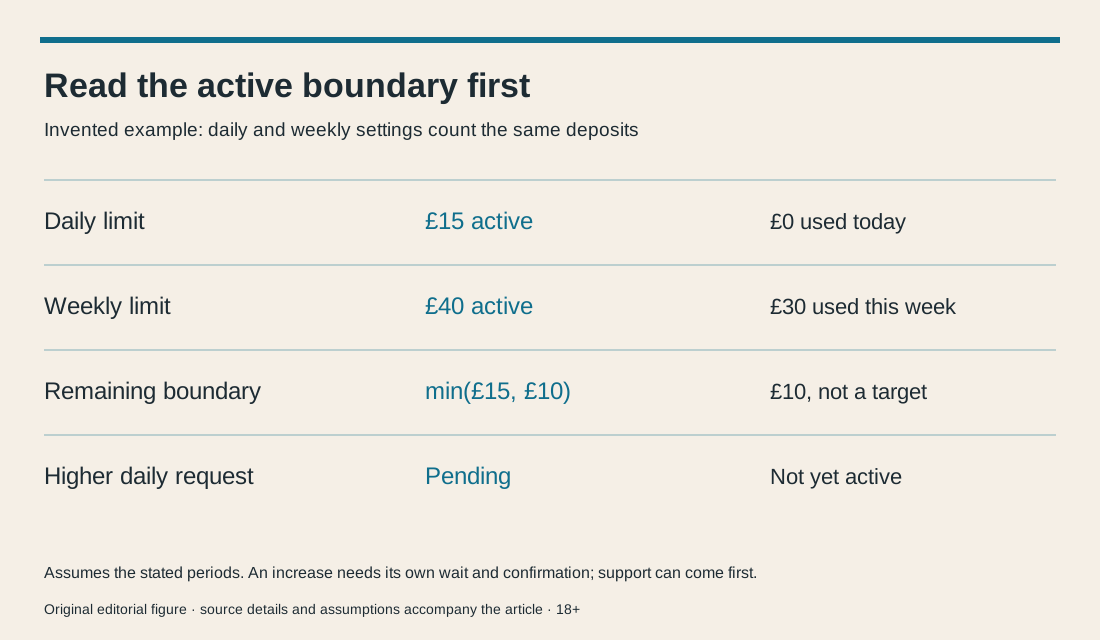
Consider fictional settings of a £15 daily limit and a £40 weekly limit, with £30 already deposited in the relevant week and nothing deposited in the current day. Assume both limits count the same kind of deposits and their periods have been correctly identified. The remaining daily room is £15.
The remaining weekly room is £40 minus £30, or £10. The tighter remaining boundary is £10.
This is an illustration of how limits interact, not an invitation to deposit £10. The available amount is not a target and tells us nothing about what the person can afford. We use invented values because the arithmetic is easier to inspect when no real account or recommendation is implied.
If the daily amount were eventually increased to £25 while the weekly setting and prior deposits stayed unchanged, the weekly remainder would still be £10. Increasing one setting does not, by arithmetic alone, increase another. The Commission's guidance says simultaneous time frames should apply the lowest applicable limit.
The figure keeps the active daily amount, weekly remainder and pending request separate. It deliberately leaves out any countdown to a new gambling opportunity. Its purpose is to show why one prominent number can fail to describe the boundary actually constraining the account.
| Setting | Amount or status | Context |
|---|---|---|
| Daily limit | £15 active | £0 used today |
| Weekly limit | £40 active | £30 used this week |
| Remaining boundary | min(£15, £10) | £10, not a target |
| Higher daily request | Pending | Not yet active |
Sources: RTS 12 – Financial limits.
A reset and an increase are different events
A reset is about when a period starts again. An increase changes the amount of the chosen boundary. A cooling-off period concerns a request for that higher amount.
These can involve clocks on the same screen, but their dates do not mean the same thing.
Ask whether the period is fixed or rolling and what time zone is used. For a fixed period, ask when the next boundary starts. For a rolling period, ask how earlier transactions leave the calculation.
If the page does not tell you, leave the answer blank in your record until the operator explains it. We have not tested any named casino's reset behaviour.
In our fictional daily-and-weekly example, midnight does not automatically mean the weekly remainder is restored. That depends on the weekly period definition. Likewise, a weekly reset does not prove that a pending daily increase has been confirmed.
Keeping those events separate prevents a misleading note such as limit resets tomorrow from standing in for three unanswered questions. It also avoids treating a date on a screen as an instruction to resume gambling.
Sources: Implementation extension for new deposit limit requirements.
Ask about the reset before trusting a date
If the page does not tell you, leave the answer blank in your record until the operator explains it. We have not tested any named casino's reset behaviour.
- You can stop here. Nothing on this page is saved or sent.
Ticks are kept only in this browser and are never sent anywhere.
Keep the September change attached to its date
The Commission's notice of 26 May 2026 extended the second phase of deposit-limit changes to 30 September 2026. It says operators must offer gross deposit limits, reserve the name deposit limit for that type and give it at least equal prominence alongside other financial limits.
The notice also specifies fixed time frames for gross deposit limits, while other limit types may use fixed or rolling periods.
At this article's 19 September source check, that effective date is still ahead. Do not read those future requirements as proof that every current account screen already uses the new terminology. An existing screen may need its definition checked particularly carefully around the change.
Gross deposits count money added without subtracting withdrawals. A hypothetical £30 deposit followed by a £10 withdrawal therefore still represents £30 of gross deposits. This explanation concerns what the measure counts; it is not a way to calculate a recommended spending allowance.
If the article is read after the effective date, recheck the current official requirements and the operator's explanation. A document date and a live account observation are different forms of evidence. We have verified the published notice, not implementation across casino accounts.
Sources: Implementation extension for new deposit limit requirements.
Words used on this page
- Deposit limit
- A ceiling on money added to the gambling account over a stated period. It does not describe every stake made from an existing balance.
- Cooling-off period
- The wait of at least 24 hours between a customer's request for a higher limit and the point at which it can be positively confirmed.
- RTS 12D
- The part of the Gambling Commission's remote technical standards that sets the rules for financial limits, including increases and reductions.
- Gross deposits
- Money added to the account without subtracting withdrawals.
- Fixed period
- A limit period that starts again at a set point. Ask when the next boundary starts.
- Rolling period
- A limit period measured back from the present. Ask how earlier transactions leave the calculation.
Lowering a boundary does not require using it first
You can decide that an existing limit is too high without reaching it. A limit is a ceiling on a defined measure, not an amount that needs to be used. If you request a reduction, keep the acknowledgement and check when the lower setting is shown as active.
The technical-failure exception in RTS 12D also requires the customer to be told when the reduction will take effect.
If a requested reduction does not appear, use the operator's support route to ask what remains in force and when the change will apply. You can step away while that is clarified. There is no need to place a small bet or deposit to test whether the control works.
Other practical support can sit alongside an account setting. The NHS suggests talking to someone you trust and asking your bank about blocking payments to gambling services. Those steps need their own scope checks; an account limit is not a bank block, and neither is a guarantee of safety.
If gambling is creating pressure to recover money, increasing a number will not establish that further play is manageable. Support can begin with that concern, without a completed worksheet or a particular level of loss.
Sources: RTS 12 – Financial limits; Help for problems with gambling.
Lower a boundary without using it first
A limit is a ceiling on a defined measure, not an amount that needs to be used. There is no need to place a small bet or deposit to test whether the control works.
- You can stop here. Nothing on this page is saved or sent.
Ticks are kept only in this browser and are never sent anywhere.
Take the record to a conversation if it helps
A useful private note can be short: what the control counts, the active amount and period, any pending request, and the response to a requested reduction. It does not need bank statements, account passwords or a complete gambling history. This page collects none of those details and does not diagnose or score you.
GamCare offers confidential support for people concerned about their own gambling and for friends or family. Its page also directs people who need immediate help and cannot reach it to Samaritans on 116 123, with 999 for emergencies.
The NHS describes specialist gambling treatment clinics in England and says people can self-refer or ask a GP about local services; access details belong to the relevant service.
No control or conversation is promised to produce a particular treatment outcome here. The practical aim is smaller: make the present boundary clear and keep a route to another person available. You can choose that conversation before making any change to a casino account.
Sources: Chat to us now; Help for problems with gambling.
Keep a short private note
It does not need bank statements, account passwords or a complete gambling history. This page collects none of those details and does not diagnose or score you.
- You can stop here. Nothing on this page is saved or sent.
Ticks are kept only in this browser and are never sent anywhere.
Questions answered
How do I set a deposit limit that cannot be raised quickly?
Read the active limit and the operator’s increase procedure. RTS 12D requires at least 24 hours of cooling off plus positive confirmation afterwards for a customer-led increase; a timer ending alone is insufficient.
Why is a limit a boundary, not a guarantee?
It controls a defined amount or activity within a stated scope. It cannot establish that gambling is affordable or safe for your circumstances, and its available amount is not a target.
What is the easiest way to stop gambling?
There is no single route that suits everyone. You can stop now, contact GamCare and ask about practical support without first completing or increasing an account limit.
How do I get help for gambling-related harms?
Contact the support routes above; friends and family can seek help too. In England the NHS also describes self-referral to specialist gambling clinics. Call 999 for an emergency.
Do I have to confirm a higher limit when the cooling-off period ends?
No. If you no longer want an increase, you do not need to confirm it. Check the operator's instructions for cancelling a pending request and ask support if its status is unclear.
Does a daily reset restore my weekly limit?
Not by itself. In the fictional daily-and-weekly example, midnight does not automatically mean the weekly remainder is restored; that depends on the weekly period definition.
What changes on 30 September 2026?
The Commission's notice of 26 May 2026 extended the second phase of deposit-limit changes to 30 September 2026: operators must offer gross deposit limits, reserve the name deposit limit for that type and give it at least equal prominence. At the 19 September source check that date was still ahead.
Do I need to use up a limit before lowering it?
No. A limit is a ceiling on a defined measure, not an amount that needs to be used. If you request a reduction, keep the acknowledgement and check when the lower setting is shown as active.
Support sources
Continue reading
Making space for a pause: the routes that exist, what each covers, and how to start
The National Gambling Helpline is 0808 8020 133 in England and Scotland and 0808 2819 265 in Wales, 24 hours a day. A pause can start with one practical change, and the routes are set out below.
Read Making space for a pause: the routes that exist, what each covers, and how to start
How to cancel self exclusion casino: the routes that exist, what each covers, and how to start
A GamStop self-exclusion cannot be cancelled during the period you chose, and it stays in place afterwards until you ask for it to be removed. Bank blocks, blocking software and phone settings each have their own way of being undone. This page sets out each route from the provider's own page, read 21 September 2026, with the helpline first.
Read How to cancel self exclusion casino: the routes that exist, what each covers, and how to start
Choosing between a gambling time-out and self-exclusion
A short pause and a longer exclusion cover different needs. Compare the duration, coverage and return conditions before relying on a label in an online casino account.
Read Choosing between a gambling time-out and self-exclusion
A limit is a boundary, not a guarantee of safety
A number alone cannot decide whether gambling is manageable for a particular person.
Read A limit is a boundary, not a guarantee of safety
Block gambling sites on your phone: every route, compared
GAMSTOP, Gamban, BetBlocker, a bank block and your phone's own settings each cover different ground. A sourced comparison and a step-by-step setup order.
Read Block gambling sites on your phone: every route, compared
How can I stop online casino gambling and find support?
Understand Gamstop Online, device blocks, bank support and talking to someone, with a simple private next-step aid and current source links.
Read How can I stop online casino gambling and find support?
Continue reading
How to cancel self exclusion casino: the routes that exist, what each covers, and how to start
A GamStop self-exclusion cannot be cancelled during the period you chose, and it stays in place afterwards until you ask for it to be removed. Bank blocks, blocking software and phone settings each have their own way of being undone. This page sets out each route from the provider's own page, read 21 September 2026, with the helpline first.
Read How to cancel self exclusion casino: the routes that exist, what each covers, and how to startChoosing between a gambling time-out and self-exclusion
A short pause and a longer exclusion cover different needs. Compare the duration, coverage and return conditions before relying on a label in an online casino account.
Read Choosing between a gambling time-out and self-exclusionMaking space for a pause: the routes that exist, what each covers, and how to start
The National Gambling Helpline is 0808 8020 133 in England and Scotland and 0808 2819 265 in Wales, 24 hours a day. A pause can start with one practical change, and the routes are set out below.
Read Making space for a pause: the routes that exist, what each covers, and how to startMaking space for a pause: the routes that exist, what each covers, and how to start
A limit is a boundary, not a guarantee of safety
Block gambling sites on your phone: every route, compared
How to cancel self exclusion casino: the routes that exist, what each covers, and how to start